
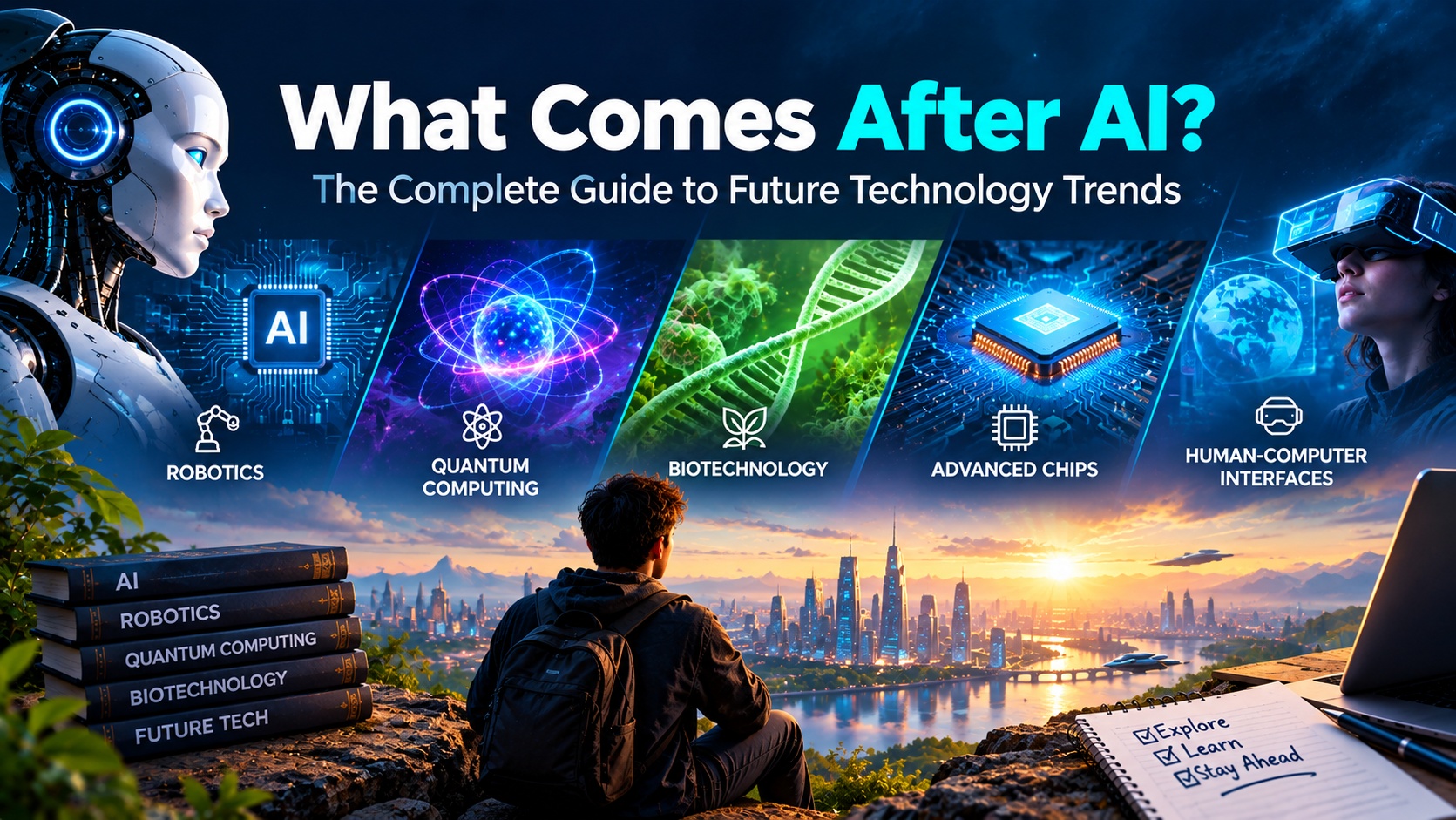

Artificial intelligence is still developing, so asking what comes after AI may seem premature. But technology rarely moves in a straight line. The next major shift may not be a single invention that replaces AI. It is more likely to come from technologies that make AI more capable, connect it to the physical world, or change the way humans interact with computers.
Robotics, quantum computing, brain-computer interfaces, advanced semiconductors, spatial computing, biotechnology, new energy systems, and post-quantum cybersecurity are already being developed. Some are still experimental. Others are moving into commercial products.
What is happening to AI right now?
AI is moving beyond systems that simply respond to prompts.
Today’s models can generate text, images, audio, video and software code. The next stage is increasingly focused on systems that can perform sequences of actions, use external tools, work with software and respond to changing information.
This is where AI agents become important.
Instead of asking an AI model to write an email and then sending it yourself, an agent could potentially read relevant information, prepare the email, check details, send it through an authorized service and report what happened.
The difference is mainly about action.
A chatbot primarily produces an answer. An agent is designed to complete a task.
That does not mean agents will automatically become reliable digital employees. They still face problems involving incorrect decisions, security, permissions, unpredictable environments and the cost of running complex AI systems.
Still, agentic AI is an important part of understanding what comes next because many future technologies will use AI as their software layer.
AI may become infrastructure rather than the destination
There is another way to think about the future.
Instead of AI being treated as one category of technology, it may become a basic computing capability embedded into many other technologies.
A robot can use AI to understand its surroundings.
A medical device can use AI to interpret biological information.
A vehicle can use AI to make decisions.
A cybersecurity system can use AI to detect unusual activity.
A manufacturing machine can use AI to identify defects.
In these examples, AI is not necessarily the product that people notice. It is part of the system underneath the product.
This is why the technologies that come after today’s AI wave may not actually replace AI. They may use AI to do things that software alone cannot do.
-
Robotics and physical AI
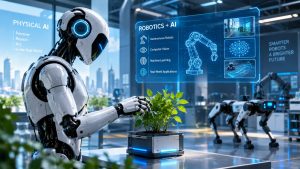
One of the strongest candidates for the next major technology wave is robotics.
AI has become very good at processing digital information. Robots bring similar capabilities into the physical world.
A robot needs to see objects, understand its surroundings, plan movements, manipulate objects and respond when something unexpected happens. AI can contribute to several of those tasks.
This is sometimes described as physical AI.
Industrial robots are already common in factories, but newer systems are being designed to operate in less controlled environments. Companies are working on robots for warehouses, manufacturing, logistics, healthcare, agriculture and eventually household tasks.
The challenge is much harder than building a chatbot.
A software system can make a mistake in a sentence and try again. A physical robot can drop an object, damage equipment or collide with something.
Hardware also has to be affordable, durable and safe.
That is why widespread humanoid robots are not guaranteed simply because AI models are improving.
Still, robotics is attracting substantial investment. In the first half of 2026, more than $33 billion reportedly went into robotics startups, according to reporting by Business Insider.
Where robotics could become useful
Some of the more realistic applications include:
- warehouse picking and transportation
- factory assembly and inspection
- agricultural operations
- hospital logistics
- infrastructure inspection
- disaster-response systems
- autonomous vehicles
- household assistance
The important development is not necessarily a humanoid robot that looks like a person.
A specialised machine that performs one difficult task reliably can be more useful than a general-purpose robot.
-
Quantum computing
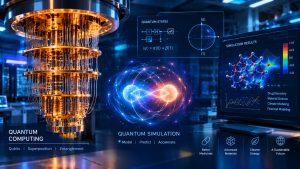
Classical computers process information using bits. Quantum computers use quantum states called qubits.
That difference allows quantum computers to approach certain computational problems in a fundamentally different way.
Quantum computing is often presented as a future replacement for conventional computers. That is misleading.
Quantum computers are not expected to replace laptops, smartphones or ordinary data centres. They are being developed for specific classes of problems where quantum algorithms could eventually provide advantages.
Potential areas include chemistry, materials science, optimisation and cryptography.
The technology is still developing, and practical large-scale quantum computing remains difficult because qubits are sensitive to noise and errors.
IBM, for example, currently describes a roadmap toward a large-scale fault-tolerant quantum computer and has announced a target of 2029 for its Starling system. That is a company roadmap, not a guarantee that the industry will meet the date.
That distinction matters.
Quantum computing could become extremely important, but many proposed applications are still being researched. The industry still has to demonstrate where quantum machines provide useful advantages over classical alternatives.
-
Post-quantum cybersecurity

Quantum computing creates another technology trend that is easier to overlook: post-quantum cryptography.
Modern digital systems rely heavily on cryptographic algorithms to protect communications, websites, financial transactions and stored information.
Powerful future quantum computers could threaten some of today’s widely used public-key cryptographic systems.
The response has already started.
In August 2024, the U.S. National Institute of Standards and Technology approved three post-quantum cryptography standards: FIPS 203, FIPS 204 and FIPS 205. These are designed to provide cryptographic methods that can resist attacks from future quantum computers.
This means the quantum era is not only about building quantum computers.
It is also about upgrading today’s internet infrastructure before those machines become capable of breaking vulnerable cryptography.
For companies, this creates demand for cryptographic inventories, migration plans, updated software and systems that can switch algorithms when required.
-
Brain-computer interfaces
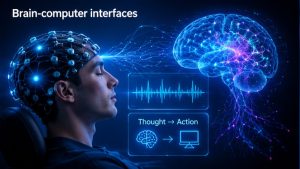
Another possible direction is to reduce the distance between the human brain and computers.
Brain-computer interfaces, or BCIs, are systems that detect neural activity and translate it into computer commands.
The idea sounds futuristic, but BCI research already exists in medical applications. Researchers have demonstrated systems that allow people with severe physical disabilities to interact with computers using neural signals.
The long-term possibilities are much broader.
A BCI could potentially allow a person to control a cursor, robotic device or other digital system without conventional physical input.
Two-way interfaces are even more ambitious. Instead of only reading neural activity, future systems could potentially send information back into the nervous system.
However, claims about computers literally “reading minds” should be treated carefully.
Human thoughts are complicated, neural signals vary between people, and translating brain activity into precise language or intentions remains a difficult research problem. Current BCI technology should not be confused with science-fiction-style mind reading.
The field is nevertheless receiving increasing investment. The Financial Times reported that venture funding for neurotechnology rose from $2.3 billion in 2024 to $4.8 billion in 2025.
-
Spatial computing and new interfaces
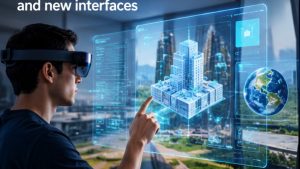
For decades, humans have interacted with computers through keyboards, mice and touchscreens.
Spatial computing could change that relationship.
Instead of treating the computer as a flat rectangle, spatial computing places digital information into a three-dimensional environment.
This includes technologies such as augmented reality, virtual reality and mixed reality.
Imagine an engineer looking at a machine while digital instructions appear next to the relevant component.
A student could examine a three-dimensional model of the human heart instead of looking at a flat diagram.
An architect could walk through a digital version of a building before construction begins.
These applications do not require the technology to replace smartphones or computers.
The more realistic future may involve different interfaces being used for different jobs.
Phones remain convenient for quick tasks. Spatial devices could become useful when visualising complex information, training workers or interacting with three-dimensional environments.
-
Advanced semiconductors and specialised computing

AI has also exposed a basic limitation of modern computing: advanced software requires enormous amounts of hardware.
Training and running large AI models can require specialised processors, high-bandwidth memory, networking equipment and large data centres.
This creates another important technology trend: specialised computing hardware.
Instead of building one processor that performs every type of task equally well, companies are designing chips for particular workloads.
GPUs became central to modern AI computing. Other specialised accelerators are being developed for inference, networking, edge computing and other workloads.
This trend could continue beyond AI.
As robotics, autonomous systems, scientific computing and real-time applications grow, demand will increase for processors that deliver more computation while using less electricity.
The future of technology is therefore not only about new software.
It is also about the physical hardware that makes that software possible.
-
Edge computing
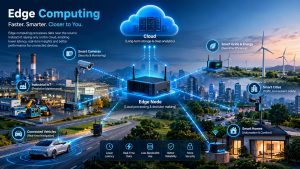
Cloud computing moved much of the world’s computing infrastructure into large remote data centres.
The next step is not necessarily to abandon the cloud. It is to combine cloud computing with edge computing.
Edge computing processes data closer to where it is generated.
Consider an autonomous vehicle.
Sending every camera frame to a distant data centre before deciding whether to brake would introduce unnecessary delay. Some decisions need to happen inside the vehicle.
The same principle applies to factories, drones, security cameras, medical equipment and industrial machines.
A future system may therefore use several layers:
Device → Edge computer → Cloud → AI service
The device handles immediate tasks. Edge hardware processes time-sensitive information. The cloud handles larger workloads, storage and coordination.
This hybrid approach becomes particularly important as billions of devices generate more data.
-
Biotechnology and computational biology

Computing is increasingly being combined with biology.
Modern biotechnology can generate enormous amounts of biological data. Computers can help researchers analyse that information, model biological processes and search through potential treatments or molecules.
AI is already contributing to this area, but the broader trend goes beyond AI.
Advances in gene editing, synthetic biology, personalised medicine, biological sensors and laboratory automation could change how diseases are diagnosed, studied and treated.
The interesting part is the combination.
A future laboratory could use automated equipment to run experiments, software to analyse results and machine-learning systems to identify promising candidates.
The result would be a tighter connection between computation and physical experimentation.
That is very different from simply asking a chatbot a question.
-
New energy technologies
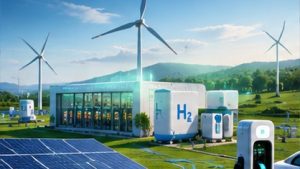
Computing growth has an energy cost.
Data centres require electricity. Electric vehicles require charging infrastructure. Robotics, manufacturing and advanced computing all depend on reliable energy supplies.
That makes energy technology another important part of the future technology landscape.
Areas receiving attention include:
- advanced battery systems
- grid-scale energy storage
- next-generation solar technologies
- nuclear power
- fusion research
- smart electricity grids
- improved power electronics
Fusion is an especially interesting example, but it should not be presented as a technology that is already ready to replace today’s energy sources.
The more immediate story is broader: technology companies and governments need more efficient ways to generate, store and distribute electricity as digital infrastructure expands.
-
Autonomous systems

Autonomy is another major direction.
An autonomous system does not simply follow a fixed sequence of commands. It can observe its environment, make decisions and perform actions with limited human intervention.
Self-driving vehicles are one example.
Drones, warehouse machines, agricultural equipment and industrial inspection systems are others.
AI is a major component of autonomy, but autonomy also depends on sensors, control systems, robotics, communications, mapping, navigation and safety engineering.
This makes autonomous technology an example of how several fields are merging.
The future vehicle, for example, is not simply a car with an AI model installed inside it. It is a computing platform connected to sensors, cameras, networks, maps, actuators and safety systems.
So, what actually comes after AI?
There probably will not be one technology that simply takes AI’s place.
A more realistic scenario is that AI becomes part of a larger technology stack.
Think of the progression this way:
Internet → Cloud → AI → AI-powered physical and scientific systems
The internet connected computers.
Cloud computing made large-scale computing and storage available through networks.
AI added systems capable of generating, interpreting and predicting information.
The next stage could connect those capabilities to physical machines, scientific instruments, biological systems and new human-computer interfaces.
That is why robotics, quantum computing, biotechnology, spatial computing and autonomous systems are worth watching.
They represent different directions in which computing can expand.
Which future technologies are closest to mainstream adoption?
Not every technology on the list has the same timeline.
Some are already commercial. Others may take many years to become practical.
| Technology | Current position | Likely direction |
| AI agents | Early commercial adoption | Wider automation |
| Robotics | Commercial, rapidly developing | More capable physical systems |
| Edge computing | Already deployed | More real-time processing |
| Spatial computing | Commercial but developing | More specialised applications |
| Quantum computing | Research and early commercial access | Larger, fault-tolerant systems |
| Brain-computer interfaces | Primarily medical/research | Broader human-computer interaction |
| Biotechnology | Commercial and research | More computational biology |
| Post-quantum cryptography | Standards already available | Migration across infrastructure |
| Advanced energy systems | Mixed maturity | Greater storage and generation capacity |
| Autonomous systems | Commercial in selected areas | Expansion into new environments |
The important point is that “future technology” does not necessarily mean something twenty years away.
Some technologies become important gradually while they are still improving.
How to identify the next technology trend
You do not need to guess which startup will become the next giant company.
Instead, watch for several signals.
- Follow research, not just social media
Technology trends often appear in academic papers, research laboratories and engineering announcements before they become mainstream products.
Following universities, research organisations and company research divisions can reveal developments earlier than general technology news.
- Watch what companies are actually building
Announcements are useful, but products, prototypes and deployments provide stronger evidence.
If a technology repeatedly moves from research into real-world testing, it deserves more attention.
- Look for infrastructure
Infrastructure is often less visible than consumer products.
Data centres, semiconductor manufacturing, networking, batteries, robotics components and cybersecurity standards can reveal where the industry is heading.
- Watch investment carefully
Investment can indicate that companies see commercial potential.
But investment is not proof that a technology will succeed.
The current robotics boom is a good example. Large amounts of capital are entering the sector, but developers still face difficult engineering and commercial problems.
- Look for falling costs
A technology becomes much more interesting when the cost of using it falls.
This happened with computing, storage and many digital services.
The same pattern could help robotics, advanced sensors, energy storage and other emerging technologies reach more users.
How to learn future technologies
You do not need to become an expert in every emerging field.
Start with the fundamentals.
For AI, learn machine learning concepts, generative AI, AI agents and how models are deployed.
For robotics, learn sensors, control systems, computer vision and basic electronics.
For quantum computing, learn basic quantum concepts, qubits, quantum gates and why error correction matters.
For biotechnology, start with genetics, molecular biology and computational biology.
For cybersecurity, understand encryption, authentication, networking and post-quantum cryptography.
The goal is to understand how the technology works and what problem it solves, rather than memorising a list of trendy companies.
A practical way to track technology trends
Create a simple technology watchlist.
Divide it into five categories:
Current: Technologies already being widely used.
Growing: Technologies moving quickly from experimentation into commercial products.
Early: Technologies with promising research but limited deployment.
Experimental: Technologies where practical applications remain uncertain.
Long-term: Ideas that could become important but require major scientific or engineering breakthroughs.
Review the list every few months.
This prevents you from treating every viral technology announcement as the next big thing.
What should students learn for the future?
Students do not necessarily need to learn every new programming language or technology.
A better strategy is to build skills that remain useful across technology cycles.
Learn how computers and networks work.
Understand AI well enough to use it effectively.
Learn data analysis and basic automation.
Develop communication and research skills.
Understand cybersecurity fundamentals.
If you are interested in emerging technology, learn how to read technical documentation and evaluate claims rather than relying entirely on short social-media videos.
For someone entering the technology industry without wanting to become a software developer, areas such as digital marketing, product operations, technical sales, cybersecurity operations, data analysis, AI-assisted business operations and technology content can provide different entry points.
The exact choice depends on the person’s interests and the skills they are willing to develop.
The biggest mistake when predicting future technology
The easiest prediction is often the wrong one.
A technology can be technically impressive and still fail commercially.
Another technology can appear boring but become extremely important because companies can deploy it cheaply and reliably.
This is why headlines about “the next AI” should be treated cautiously.
Quantum computing may become extremely important, but the timing of widespread commercial advantage remains uncertain.
Humanoid robots may become useful in some industries, but reliable general-purpose manipulation is a difficult engineering problem.
Brain-computer interfaces could change human-computer interaction, but many ambitious applications remain experimental.
The useful approach is to separate what exists today, what is being tested and what is still speculation.
The technology stack of the future
The most interesting future may not come from one technology.
It could come from combinations.
Imagine a warehouse with autonomous robots.
The robots use AI for perception and decision-making.
Edge computers process sensor data locally.
Cloud infrastructure coordinates the fleet.
Advanced chips provide the required computing power.
5G or future networks connect machines.
Cybersecurity protects the system.
Energy-storage technology keeps the facility running efficiently.
In that example, there is no single “next technology.”
Several technologies work together.
That is likely to be one of the defining characteristics of the next phase of computing.
What comes after AI? The short answer
AI itself is unlikely to disappear after the current AI boom.
Instead, it may become a basic component of other technologies.
The next major technology trends are likely to include robotics and physical AI, quantum computing, brain-computer interfaces, spatial computing, advanced semiconductors, edge computing, biotechnology, autonomous systems, new energy technologies and post-quantum cybersecurity.
Some will grow quickly. Some will remain niche. Some may fail to reach their current expectations.
The technologies worth watching are the ones that move beyond impressive demonstrations and solve difficult problems at a practical cost.
For the next few years, the most useful question is therefore not “What replaces AI?”
It is:
“What can AI become when it is combined with machines, biology, new computing systems, energy and new ways of interacting with technology?”
That question points toward a future where AI is less of a standalone product and more of a computing layer inside the next generation of technology.