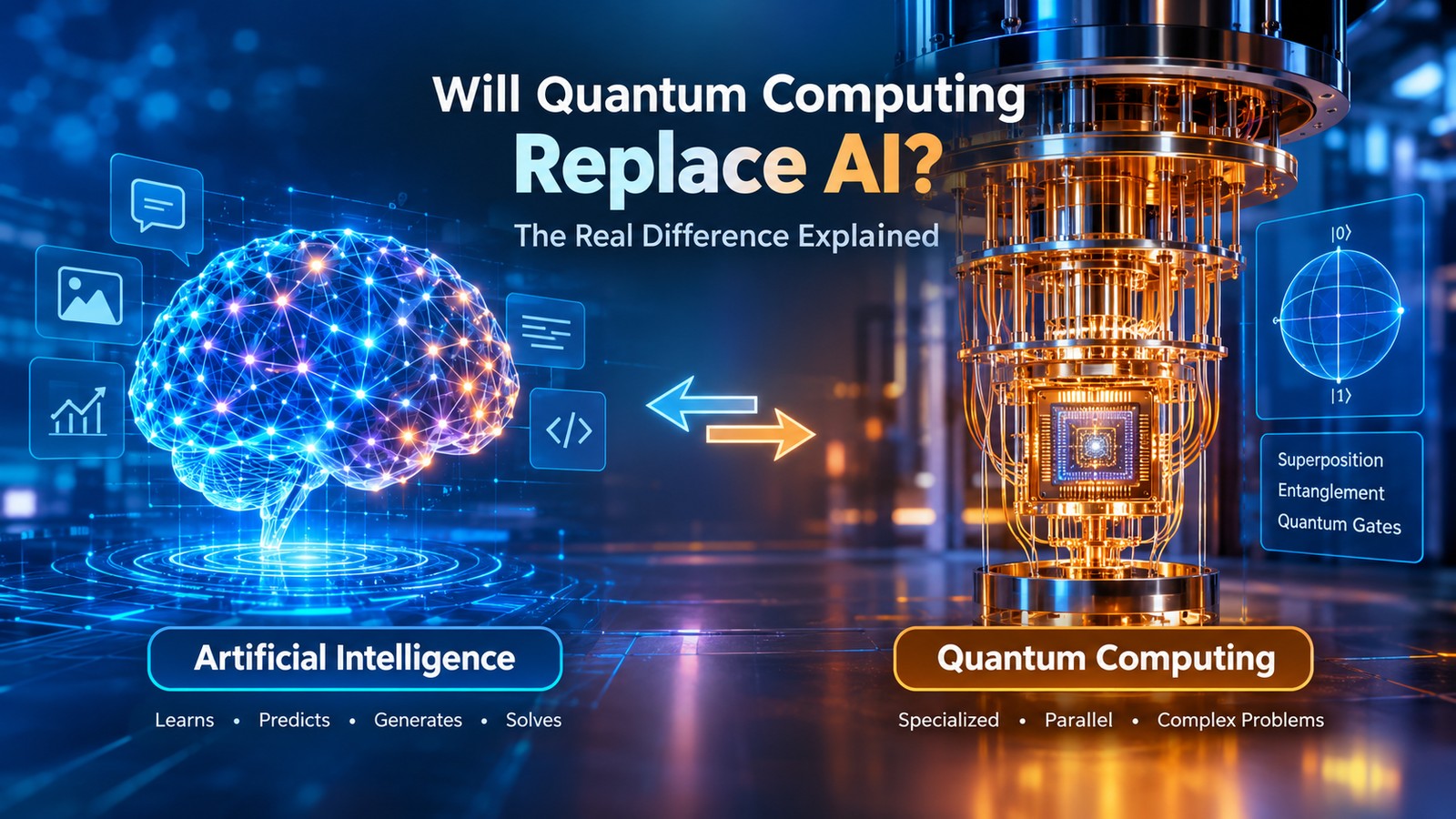

Quantum computing and artificial intelligence are often discussed as technologies that could change the future of computing. But they do not serve the same purpose, and understanding that difference is essential to answering whether one could replace the other.
Quantum computing is unlikely to replace AI. AI is a field of computing focused on tasks such as learning from data, recognizing patterns, generating content, and making predictions. Quantum computing is a different way of processing information that may offer advantages for specific computational problems.
The more realistic possibility is that the two technologies will complement each other. AI could help scientists develop and operate quantum computers, while quantum processors might eventually accelerate selected calculations used in AI or scientific research. Whether those benefits become practical depends on further research, hardware improvements, and measurable performance advantages.
What Is Artificial Intelligence?
Artificial intelligence (AI) is a field of computer science concerned with building systems that perform tasks commonly associated with human intelligence. These include understanding language, identifying objects, recognizing patterns, making predictions, and generating text or images.
Much of modern AI relies on machine learning. Instead of programming every rule manually, developers train models on data so that the models learn patterns that can be applied to new inputs.
Deep learning is a subset of machine learning that uses artificial neural networks with many interconnected computational units. Large language models, image-recognition systems, and several modern generative AI tools use deep-learning techniques.
How does AI work?
A typical AI system processes data through a model that has been trained to perform a particular task. During training, the model’s parameters are adjusted to reduce errors or improve a chosen objective. Once trained, the model can generate predictions, classifications, or other outputs.
For example, an image-recognition model can learn patterns associated with different objects from labeled images. A language model can learn statistical relationships in text and use them to generate answers, summarize documents, or assist with programming.
AI applications already operate on conventional computers using CPUs, GPUs, and specialized accelerators. They do not need quantum computers to function.
Common applications include:
- Healthcare research and medical-image analysis.
- Fraud detection and financial forecasting.
- Chatbots, translation, and document summarization.
- Software development and code assistance.
- Recommendation systems and demand forecasting.
- Robotics and autonomous-system perception.
AI is not a single product or algorithm. Its capabilities and limitations depend on the model, data, computing resources, and task.
What Is Quantum Computing?
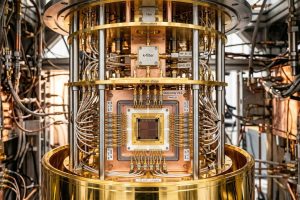
Quantum computing is a computing approach that uses principles of quantum mechanics to process information. Conventional computers use bits represented as 0 or 1, while quantum computers use quantum bits, commonly called qubits.
Qubits can occupy a combination of the 0 and 1 basis states, a property known as superposition. They can also become entangled, meaning their quantum states exhibit correlations that cannot be explained by treating each qubit independently.
Quantum algorithms use quantum operations, interference, and measurement to solve particular problems. Their advantage comes from exploiting the structure of a problem, not simply from processing every possible answer at once.
How does quantum computing work?
A quantum computation typically begins by preparing qubits in specific states. A sequence of quantum gates then transforms those states, and measurements produce classical results that can be analyzed.
The process is difficult to control because quantum states are sensitive to noise and environmental disturbances. Errors can accumulate during calculations, and reliable large-scale computing will require effective error correction and substantial engineering progress.
Quantum computing research explores several potential applications:
- Chemistry and materials science: Simulating molecular and physical systems.
- Cryptography: Understanding how quantum algorithms affect existing encryption methods.
- Optimization: Investigating specialized scheduling, routing, and resource-allocation problems.
- Scientific computing: Developing algorithms for selected mathematical and physical problems.
- Machine learning: Testing whether quantum circuits can improve particular learning or data-processing tasks.
These applications have different levels of maturity. Research into a possible advantage does not establish that quantum computers currently outperform conventional computers in that field.
Quantum Computing vs. AI: The Main Differences
Although both technologies involve advanced computing, their roles are different. AI is a collection of methods for creating systems that learn from data, while quantum computing is a way of carrying out computations using quantum-mechanical effects.
| Comparison | Artificial intelligence | Quantum computing |
| Primary purpose | Learning, prediction, generation, and decision support | Specialized computation using quantum algorithms |
| Basic mechanism | Statistical models, machine learning, neural networks | Qubits, quantum gates, superposition, and entanglement |
| Typical hardware | CPUs, GPUs, and AI accelerators | Specialized quantum processors |
| Data requirements | Often substantial training data, depending on the model | Varies by algorithm; encoding classical data can be costly |
| Current applications | Chatbots, image recognition, forecasting, automation | Quantum research, experimental algorithms, and specialized demonstrations |
| Main limitations | Data quality, computing costs, model errors | Noise, error correction, scalability, and hardware control |
| Future relationship | Could help develop and operate quantum systems | May complement AI for selected workloads |
The underlying distinction is described in IBM Quantum’s. Quantum computing introduces new computational methods; it does not automatically provide the learning capabilities associated with AI.
IBM Quantum Learning
Why the distinction matters
Consider a company developing a new medicine. Its AI system might analyze research papers, predict molecular properties, and identify promising compounds. A quantum computer might eventually help calculate certain molecular properties that are difficult to simulate accurately with conventional methods.
The two technologies could contribute to the same project without doing the same job. AI interprets patterns and generates predictions; quantum computing may help with a particular calculation.
This distinction also applies to software development, financial analysis, cybersecurity, and scientific research. The useful question is which computational approach works best for each task—not which technology is universally superior.
Can Quantum Computing Replace AI in the Future?
Quantum computing is unlikely to replace AI as a whole because the two are not equivalent technologies. One is a computing approach; the other is a broad field of methods and applications.
There are three important reasons.
- AI performs tasks that quantum hardware does not automatically provide
A quantum processor does not automatically understand natural language, recognize objects, or generate useful answers. Those capabilities require suitable algorithms, models, data, and software.
Quantum computing could potentially accelerate a component of an AI system, but the overall application would still need to interpret inputs, process results, and produce useful outputs.
- Quantum computers are not faster for every problem
A quantum computer’s performance depends on the problem and the algorithm. Some quantum algorithms offer theoretical advantages for specific tasks, but this does not mean that quantum hardware is faster at ordinary calculations, data processing, or every machine-learning operation.
A meaningful comparison must consider the complete workload, including data preparation, communication with conventional hardware, error correction, and the time required to obtain reliable results.
- Existing AI systems already run on conventional hardware
Today’s AI infrastructure uses conventional processors, GPUs, specialized accelerators, storage systems, and software frameworks. These systems support applications from personal assistants to scientific research.
Quantum computing would need to demonstrate a clear practical advantage for a particular workload before organizations had a reason to adopt it. Even then, it could complement existing hardware rather than replace the entire system.
The likely outcome is coexistence: conventional computers continue to run most applications, AI remains useful for learning and prediction, and quantum processors may be added to selected workflows where they offer a measurable benefit.
What Is Quantum AI?
Quantum AI refers broadly to research at the intersection of quantum computing and artificial intelligence. The term is used for work on quantum machine learning, quantum-assisted computations, and AI techniques that help scientists develop and operate quantum systems.
It is important to distinguish these two directions:
- Quantum for AI: Investigating whether quantum computing can improve selected AI or machine-learning tasks.
- AI for quantum: Using AI to improve quantum hardware, control, calibration, error correction, and data analysis.
The second direction is already an active research area. A review published in Nature Communications on December 2, 2025, examines how AI techniques are being applied across quantum-computer design, device control, calibration, and error correction. The authors also discuss the technical limitations that remain.
Nature Communications
How quantum machine learning works
Quantum machine learning explores whether quantum circuits can be used within learning algorithms. One approach uses a parameterized quantum circuit whose settings are adjusted during training.
A classical computer may prepare data, optimize the circuit’s parameters, and analyze its measurements. The quantum processor performs the circuit operations, and the resulting measurements feed back into the training process.
This is a hybrid quantum-classical approach, not a complete replacement for conventional machine learning.
Researchers are investigating whether these methods can offer advantages in selected applications. However, current quantum hardware has limitations, and loading ordinary digital data into quantum states can add substantial overhead. A quantum model must also be compared with strong classical alternatives before its practical value can be established.
ScienceDirect
Could quantum computing make AI smarter?
Possibly for particular tasks, but a quantum processor does not automatically make an AI model more intelligent.
For example, a future quantum algorithm might accelerate a specific scientific calculation used in a larger machine-learning workflow. That could improve the workflow’s speed or usefulness if the quantum advantage survives the costs of data preparation and hardware operation.
It would not necessarily make a chatbot better at writing, improve every image-recognition model, or reduce the cost of all AI training.
The distinction between a theoretical speedup and a demonstrated end-to-end improvement is essential when evaluating claims about quantum AI.
Real-World Applications of AI and Quantum Computing
The most promising applications may emerge when both technologies address different parts of a difficult problem.
-
Drug discovery

AI can screen candidate molecules, predict molecular properties, and help researchers prioritize experiments. Quantum computers could eventually help simulate selected molecular systems more accurately.
Current reality: AI is already used in drug research. The practical advantage of quantum computing for specific drug-discovery workflows remains an active research question.
-
Battery and materials development

AI can predict material properties and help researchers screen candidates. Quantum computing could eventually improve calculations of electronic structures and chemical interactions.
Potential benefit: Better tools for investigating battery materials, catalysts, and other complex substances.
-
Financial optimization

AI supports forecasting, fraud detection, and risk analysis. Quantum algorithms are being investigated for selected optimization problems, including certain portfolio-allocation scenarios.
Potential benefit: Better solutions for specific workloads if quantum methods outperform established classical approaches.
-
Cybersecurity

AI can help identify suspicious activity and analyze threats. A sufficiently capable future quantum computer could break some widely used public-key cryptographic systems, making post-quantum cryptography important.
Potential benefit: Stronger cryptographic protection and better security analysis, with AI and quantum computing playing different roles.
These examples illustrate potential collaboration, not a guarantee that combining the technologies will improve every application. The benefits must be tested against existing methods, costs, and operational requirements.
What Are the Main Limitations of Quantum Computing?
Quantum computing has made scientific progress, but several challenges stand between current systems and broad, practical use.
Hardware errors
Qubits can lose their quantum properties or experience errors during calculations. Quantum error correction can protect information, but reliable fault-tolerant computing requires additional resources and sophisticated control.
Cost and infrastructure
Quantum processors require specialized hardware and operating conditions. Depending on the platform, this can include cryogenic equipment, precision lasers, or complex control electronics.
Access through cloud services makes experimentation easier, but it does not eliminate hardware limitations or guarantee that a quantum calculation will be economical.
Limited practical advantage
A processor with more qubits is not automatically more useful than one with fewer, higher-quality qubits. Error rates, circuit depth, algorithm design, and the difficulty of extracting results all affect performance.
A quantum computer may perform well on a carefully selected demonstration without offering an advantage for a complete commercial application.
Classical computers remain highly capable
Conventional processors have decades of optimization behind them. GPUs are particularly effective for the large numerical workloads used in many AI systems.
Quantum computers must be compared against these optimized classical alternatives. For many ordinary computing and AI tasks, conventional hardware is likely to remain the more practical choice.
IBM Quantum Learning+1
What Should Students Learn for the Future?
For students and technology enthusiasts, the emergence of quantum computing is a reason to understand both fields—not necessarily to abandon one for the other.
- Interested in AI careers? Start with Python, statistics, machine learning, neural networks, and practical AI projects.
- Interested in quantum computing? Learn linear algebra, probability, basic quantum mechanics, and quantum algorithms.
- Interested in quantum AI? Build a foundation in Python and machine learning before experimenting with quantum circuits.
- Interested in technology research or writing? Follow scientific papers and learn to distinguish theoretical proposals from demonstrated results.
Frequently Asked Questions
Will quantum computing replace AI completely?
There is no established reason to expect quantum computing to replace AI completely. Quantum computing is a way to perform certain computations, while AI encompasses methods for learning, prediction, and content generation. The technologies are more likely to complement each other.
Is quantum computing more powerful than AI?
They cannot be ranked directly because they serve different purposes. Quantum computers may have advantages for particular computational problems, but they do not automatically provide the capabilities of an AI model.
Can quantum computers run ChatGPT?
Quantum computing is being researched for possible applications in AI, but mainstream large language models such as ChatGPT use conventional computing infrastructure. There is no established need for quantum processors to provide their current language-model capabilities.
Will quantum computing replace GPUs?
Not across the board. GPUs remain well suited to the parallel calculations used in AI. Quantum processors could complement conventional hardware for selected tasks if they demonstrate a practical advantage.
Is quantum AI already available?
Quantum machine-learning software and quantum computing research platforms are available today. However, their availability does not mean that quantum AI has broadly demonstrated better performance than classical AI in practical applications.
Which is better for a career: AI or quantum computing?
AI has broader adoption across many industries, with opportunities in machine learning, software development, data analysis, and AI applications. Quantum computing is a more specialized field involving quantum software, physics, hardware, and research. The right choice depends on your interests and existing skills.
Conclusion: AI and Quantum Computing Will Likely Work Together
Quantum computing is not a replacement for artificial intelligence. AI enables systems to learn from data, recognize patterns, generate content, and make predictions. Quantum computing provides a different approach to computation that may help solve particular problems more efficiently.
The strongest reason to watch both fields is their potential to complement each other. AI is already being investigated for quantum-device design and control, while quantum machine learning explores whether quantum processors can improve selected computational tasks.
The crucial question is whether quantum computing can deliver measurable benefits beyond what optimized classical hardware already provides. Until those advantages are demonstrated for specific workloads, AI and conventional computing will remain central to most practical applications.
For the future of technology, the most useful possibility is not quantum computing replacing AI, but both technologies working together where each offers a genuine advantage.